
L&L Review: Funding for Green Projects
On October 23rd, we heard very informative news from Project Funding at the Lunch and Leaders meeting. Patty Huddle, Vice President of Existing Business Services for Columbus 2020; and David Hull, Assistant Director for the City of Columbus Department of Development presented.
Columbus 2020 is one of six organizations contracted by the State of Ohio for the purpose of facilitating funding for a developer or business working on a project in the central Ohio region. Their goal is to net 150,000 jobs and $8 billion dollars and increase per capita spending by 2020. They intend to do this by improving infrastructure, meeting the workforce challenge, and increasing the following: manufacturing competitiveness, high growth opportunities, global trade and investment. They are here at no expense to help business owners locate whatever funding might be available for their projects and to help obtain Jobs Ohio funding.
Each county has different resources for LEED projects and different tools available. In Franklin County the Columbus- Franklin Finance Authority is managed by Jean C. Ryan. Other sources for funding include SWACO (Solid Waste Authority of Columbus); Clean Ohio programs, a Jobs Revitalization program for blighted projects that may provide Phase II DSA funding for vacant buildings; OEPA funding programs with assistance from Laura Stephenson of the Treasurer’s Office, City of Columbus and Re-Energize Ohio; and tax credits and green energy funds; to name just a few.
To learn more about funding opportunities presented by Patty Huddle and Matt McCollister of Columbus 2020 as well as obtain assistance completing incentive letters to Jobs Ohio, contact Columbus 2020 at 614.225.6063 or visit their website at http://columbusregion.com.
David Hull, Assistant Director of Development, City of Columbus provided an overview of The Green Columbus Fund, a reimbursement grant program for LEED projects started in 2011. It provides $1 million dollars annually to be distributed to private and non-profit developers building Brownfield and LEED projects. It will reimburse the grant winner for Phase I and Phase II Environmental Site Assessment costs, asbestos surveys and abatements, and physical Phase II corrective actions. It builds on Clean Ohio and successive State of Ohio programs.
In order to qualify for LEED dollars, the project must be LEED for New Construction, Core and Shell, Commercial Interiors, Existing Buildings, or Operation and Maintenance (EB; OEM). The program reimburses the application fee charged by GBCI (Green Building Certification Institute) and performance incentive boosts for LEED Gold (150%) and LEED Platinum (200%). In addition to this reimbursement application, applicants can increase their grant award through meeting the criteria set by the City of Columbus. .At the outset of the project it must be discussed with the City, submitted for review and approval by the Department of Development, and then submitted to the City Council for ordinance approval.
Sponsor Spotlight: Turner Construction Company
- How long has your firm been in business?
Turner started in New York City in 1902, but we’re about to celebrate our 50th year in Columbus. - Where are your offices located?
Turner’s Columbus office is in the Arena District on Hanover Street, just south of Huntington Park. We have offices in Cleveland, Cincinnati, and Toledo (The Lathrop Company). Turner also has offices throughout the U.S. and internationally. - How many LEED AP work at your firm?
Over 1500 LEED credentialed staff nationally, 40 in Columbus. - What is the main reason you and your firm are involved in the USGBC Central Ohio Chapter?
Turner was one of the founding members of the USGBC National organization, back in the late 90’s. Since that time, Turner has invested heavily in training and credentialing of our staff, so that we can support our clients’ goals for sustainability and/or LEED certification on all of our projects. We’ve also been actively involved in the local USGBC chapters throughout the U.S., as part of our ongoing commitment to USGBC and the Mission. When the opportunity to start a USGBC chapter in Central Ohio became a reality, we jumped in and became a leading supporter. - What types of projects are you focusing on right now? OR What disciplines do you regularly need to partner with on your projects?
We’re working on the Columbus Metropolitan Library’s Vision 2020 program to build or renovate 10 branches, all scheduled to achieve LEED certification at varying levels. The Library’s commitments to sustainability, and improving the experience for the library users and their communities, are really inspiring. And we’re working with leading, local design firms to deliver outstanding projects – NBBJ, Jonathan Barnes, Design Group, Moody Nolan, Schooley Caldwell, Korda, Prater, Heapy, EMHT, etc…. – it’s been a great experience working with CML and these design firms on sustainable projects that benefit our communities.
Small Business Spotlight: Jonathan Meier, Rain Brothers co-owner:
An interview with Jonathan Meier, Rain Brothers co-owner:
1. How long has your firm been in business?
Eight years.
2. How did you become interested in sustainable design/construction?
I originally moved toward sustainable construction through working and living in an economically depressed neighborhood in Columbus. I wanted to do something in the neighborhood to create employment opportunities that provided fair wages, provided meaningful work, and demonstrated environmental stewardship. Our company started when I – along with my good friend Gordy Smith and five young men from the neighborhood – started constructing large- and small-scale rainwater harvesting systems in our backyard for urban farmers throughout Columbus. It grew into a passion from there. I also come from several generations of well drillers, so working with water is in the blood. Passion + Roots = Let’s Do This Thing!
3. What was your first job in the industry?
We put in a large underground system at the Ohio Governor’s Residence early on in our business. Through the encouragement of Hope Taft (who was head of the native conservation efforts in the backyard of the Residence), we installed a 3,000-gallon catchment system with irrigation. Needless to say, it was a bit intimidating to go at an underground system in this high-profile setting.
4. What are a few projects your most proud of?
We have done several large-scale rainwater systems for commercial applications – those are always rewarding from an ethical standpoint because they tend to have the biggest effect. But, honestly, the projects that I am most proud of are the ones where we’re given a tight budget and asked to design a thoughtful system. Challenges of this sort give me the most hope for change because it forces us to build out of necessity (instead of habit and comfort) and it pushes us to be more creative and more accessible with our work. I do not feel like we’re doing any justice to the greater good unless we can develop cost-effective, easily-implementable water solutions. The rainwater system we installed at The Ohio State University is an example of this type of system: The budget was derived from grant funding, and we were asked to develop a design-build package that would maximize system capacity and effect while minimizing cost. We also did a large-scale system for Franklin Park Conservatory that was quite enjoyable to design.
5. What is your vision for energy and environmental design in the next decade?
My vision for energy and environmental design in the next decade involves having the green movement station itself amongst the poor. “Necessity is the mother of all innovation/invention.” None know that better than those who live day-to-day in a position of necessity. I have seen some amazingly innovative things constructed by people who are just trying to get by right here in Columbus (including several bike- and human-powered machines). Those who struggle have much to contribute and much to gain from environmental policies, so the marriage of the movement with struggling communities is natural.
6. What do you see as the greatest challenges for developing a sustainable built environment?
Cost is certainly a large factor in the stalling of a transition into a green economy. But the speed at which things happen in construction is, I would argue, an obstruction to true progress. I am often both amazed and troubled by how quickly things happen. In our experience with Rain Brothers, often times, sustainable design is an afterthought or an addition instead of an approach. It is completely understandable that things happen so quickly (especially since few can afford to be slow and deliberate). Nonetheless, we have found that quickness generally impedes sustainability.
7. How does (or can) the USGBC-COH help you overcome these challenges?
Perhaps by highlighting (through publications?) cost-effective, easily implementable green construction practices. And I’m not talking about screwing in an LED light bulb – but rather stories geared toward engineers, contractors, and architects from engineers, contractors, and architects about how to, say, simplify or modularize underground housing, or how to construct more healthy, naturally-aerated ponds that serve as natural swimming pools as well as irrigation sources (because, let’s face it, rainwater harvesting tanks are expensive), etc.
8. What types of projects are you focusing on right now?
We are working on installing some pilot fire protection tanks (underground) in rural parts of Ohio. We are also getting ready to install a large-scale rainwater reuse system for Mitchell’s Ice Cream in Cleveland, and are working on a large-scale stormwater management system utilizing best management practices for a ranch north of Columbus.
9. Finish this statement: Early in my career, I wish someone had told me…..
That growing a small business sucks. Few people will appreciate a job well done. Even fewer will recognize personal sacrifice for the business’ and/or customer’s sake. And hardly anyone will know when you’re working ridiculous hours and making very little. Realizing this is helpful, because it might make it easier to say “no” to jobs that don’t serve you, your ethic, and/or your business.
10. Finish this statement: I wish I had more time to…
Farm, network, start other small businesses, cook
USGBC and the American Chemistry Council to Work Together to Advance LEED
WASHINGTON, DC - (August 27, 2014) - The U.S. Green Building Council (USGBC) and the American Chemistry Council (ACC) today announced a new initiative designed to ensure the use of sustainable and environmentally protective products in buildings by applying technical and science-based approaches to the LEED green building program. This new initiative acknowledges USGBC’s success in leading the transformation of the built environment and sets up a pathway to take advantage of the materials science expertise of ACC and its members.
“USGBC and ACC share the goal of advancing sustainability in the built environment, and we will work together to take advantage of our collective strength and experience,” said Rick Fedrizzi, president, CEO and founding chair, USGBC. “The looming impacts of climate change and the possibilities of improving human health and wellbeing favor collaboration and engagement as key strategies. The goal is forward progress.”
ACC President and CEO Cal Dooley noted, “Modern energy efficiency gains, building safety advances and carbon footprint reductions would not be possible without the products of chemistry. From windows to insulation, adhesives to flooring, chemistry provides solutions that enable the energy efficient and sustainable buildings that consumers expect in today’s world. By combining USGBC, a leader of the green building movement, with the scientific know-how of ACC, we can develop a path to stronger, science-based standards that achieve measurable progress in sustainability.”
LEED is regularly updated through a rigorous development process that includes public comments, technical review and balloting. USGBC and ACC will work within that framework to incorporate state-of-the-art safety, sustainability and life-cycle based approaches to LEED. LEED has facilitated advances in building technologies, integrated design and operating practices, as well as the tremendous growth of the green building sector, which supports or creates 7.9 million jobs across all 50 states and contributes $554 billion to the U.S. economy annually.
The American business of chemistry employs nearly 800,000 Americans and supports nearly 25 percent of the U.S. GDP. Chemistry-based plastic building and construction materials saved 467.2 trillion BTUs of energy over alternative construction materials – enough energy saved over the course of a year to meet the average annual energy needs of 4.6 million U.S. households. Energy savings made possible by innovations in chemistry in homes in the U.S. prevented nearly 283 million tons of CO2 emissions in 2010—equivalent to the greenhouse gas emissions of 50 million passenger vehicles.
Member Spotlight: James Davidson, Smoot Construction
USGBC: Which came first – your interest in sustainable building or your professional career?
JD: My professional career came first with a degree in Project Management. I have been Involved with numerous LEED projects( Several school projects and the Hollywood Casino) which led the way for my interest to become a LEED Green Associate .
USGBC: What kind of opportunities do you see in your work for developing more sustainable built environments?
JD: I see several project opportunities. It appears more and more clients are looking for LEED components in their projects (government agencies, public, and some private clients). They are looking for more efficiency with their HVAC systems and energy use. They are more interested in following good practices, using Commissioning, to insure getting a better product, and efficiently running mechanical systems.
USGBC: What motivated you to become a USGBC member?
JD: When I began studying to be a LEED Green Associate, I was also encouraged to do so by my company.
USGBC: What do you enjoy most about being a USGBC chapter member?
JD: The activities, and the networking with other companies, businesses and contractors. And, the opportunity to meet new clients.
USGBC: What is the best connection or relationship you’ve made through USGBC?
JD: People working within the construction community communicating about what makes a successful building for everybody. Sharing the common goals to provide an efficient building for the owner.
USGBC: What do you see as the greatest challenge for developing a sustainable environment?
JD: Education. Getting owners to understand that the cost factor is not nearly as high as they perceive it to be. You have to perform a life cycle analysis to fully understand the cost over the life span of the building for various components. Example: Flushless urinals may be less expensive over the life span of the building than conventional urinals when you factor in the cost for the water not utilized per flush.
USGBC: What environmental element would you like to see implemented in every project?
JD: Commissioning of HVAC Systems.
USGBC: How do you spend your time away from work?
JD: Ride my bike a lot, visit different colleges for my son and spend time with my church.
USGBC: What topic would you like to see discussed at an upcoming Lunch and Leaders meeting?
JD: Information on permeable pavements, cost comparisons to other pavements and its long-term benefits .
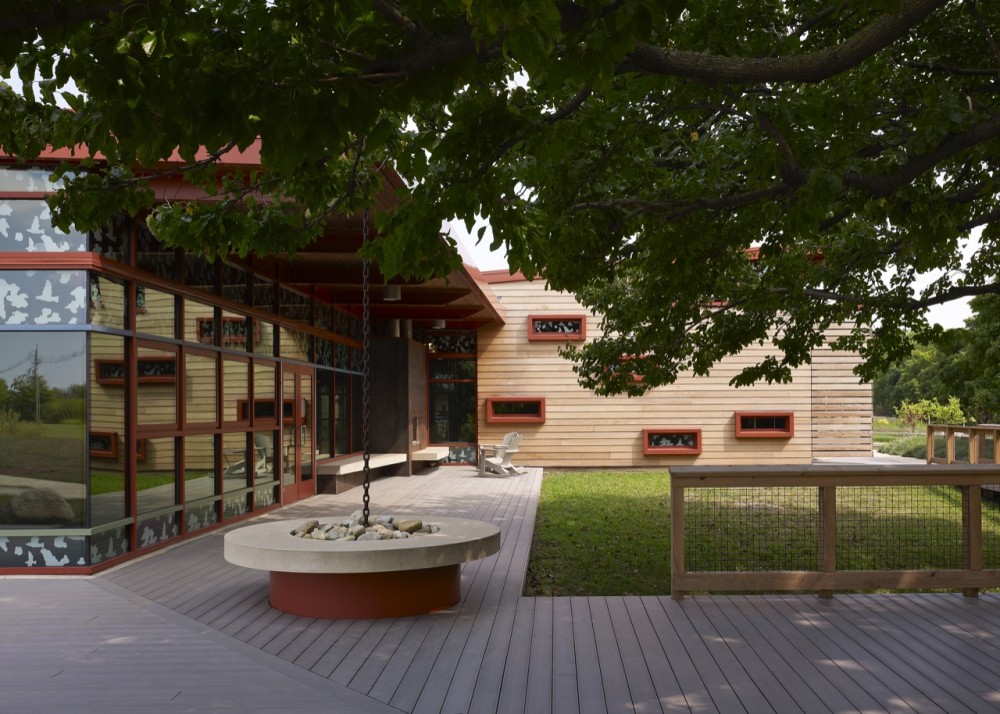
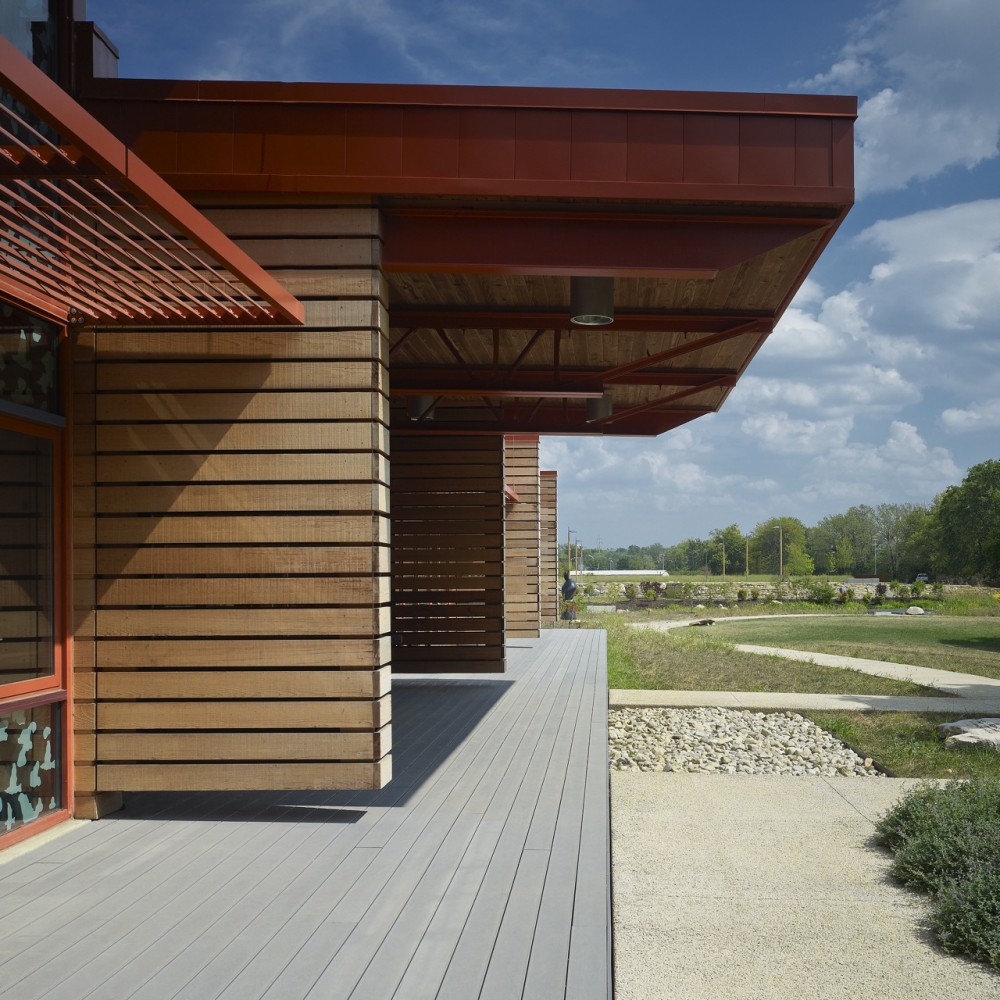
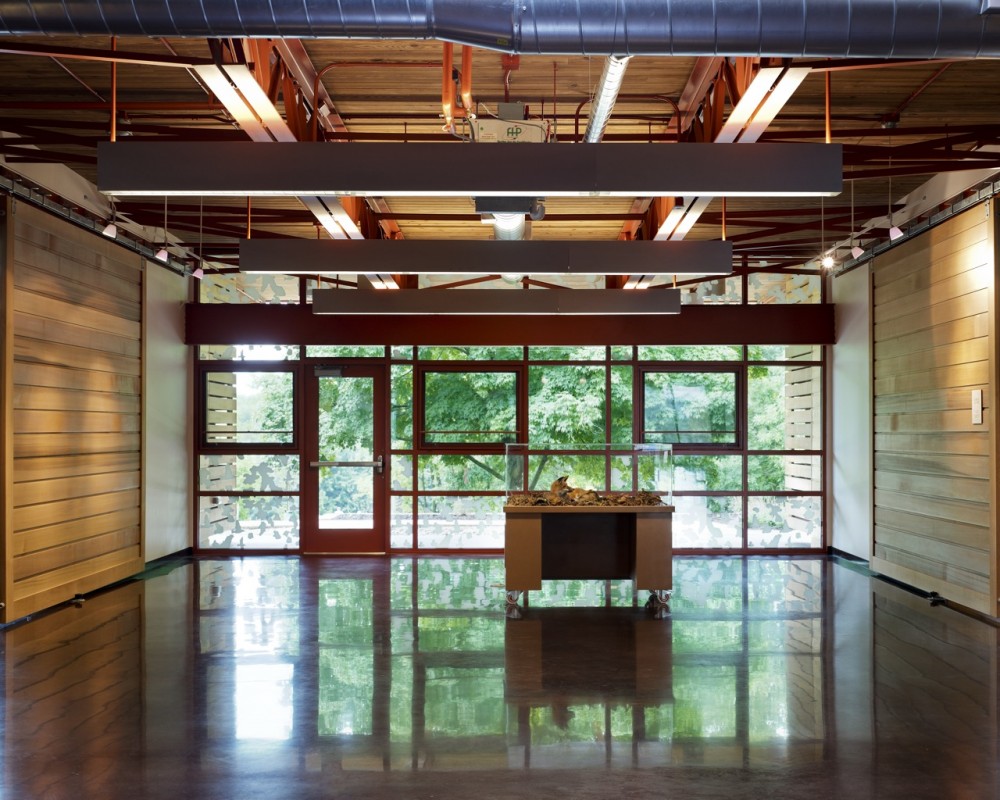
Grange Insurance Audubon Center

Located on the Whittier Peninsula of the Scioto River just south of downtown Columbus, Ohio, the Grange Insurance Audubon Center represents a catalyst for change by connecting urban youth with their natural environment. The LEED® Gold Audubon Center anchors the redevelopment of this one time brown field that has been the site of industrial facilities, warehouses and an automobile impound lot. The new 84 acre Scioto Audubon Metro Park site is a designated “important bird area” or IBA by the National Audubon Society because it is positioned on a major migratory bird flyway.
The 18,000 s.f. Audubon Center is a model for sustainable design and promotes the economic, health and aesthetic benefits of building green. The nature center celebrates the tension between contrasting elements — urban / natural, riverine / meadow and indoor / outdoor. The building’s massing, orientation, materials and mechanical systems work in concert to create an interactive facility for exploring environmental awareness, habitat restoration, conservation practices and sustainable strategies. The building is a study of architectural simplicity in building material and form, quietly nesting within its natural surroundings.
- OWNER – Grange Insurance Audubon Center Columbus and Franklin County Metropolitan Park District City of Columbus, Department of Recreation and Parks
- ARCHITECT - DesignGroup
- MEP ENGINEER - Heapy Engineering, Inc.
- STRUCTURAL ENGINEER - Shelley Metz Baumann Hawk, Inc.
- CIVIL ENGINEER - Burgess & Niple, Ltd.
- LANDSCAPE ARCHITECT - Kinzelman Kline Gossman
- ENVIRONMENTAL CONSULTANTS - Williams Creek Consulting
- GENERAL CONTRACTOR - Gutkencht Construction
- EXHIBIT DESIGN - Kraemer Design + Production, Inc.
Features
- Vegetated roof
- Geothermal ground-source heat pump system
- Passive solar design
- Mixed-mode ventilation
- 50% less energy used than a conventional building
- 88% of spaces are daylit
- 7 Acres of brownfield remediated
Member Spotlight: David Hull

Assistant Director, Department of Development, City of Columbus
Green Columbus Fund Member, Mayor Coleman’s Green Team
USGBC: Which came first – your interest in sustainable building or your professional career?
OUR WATER (Olentangy Urban Rainscapes) Green Infrastructure Project
 Neighborhood of Weinland Park, Columbus Ohio, 2011-2014
Project Partners:
Project Lead/Design – Integrity Sustainable Planning and Design
Educational Partner – Friends of the Lower Olentangy Watershed
Quantitative Assessment – MAD Scientist and Associates
Qualitative Assessment – Diversified Data
Installation – Oakland Nursery
Maintenance – Monica Desenberg, Neighborhood Resident
Developer – Wagenbrenner Company
 The OUR Water (Olentangy Urban Rainscapes) pilot project is located in an older low-income Columbus brownfield neighborhood currently being serviced by a combined sanitary and storm water sewer system. The project has been carefully crafted to educate Weinland Park neighborhood residents about practical approaches for reducing their watershed footprint and for taking personal ownership of the watershed where they live in a more sustainable way.
Project elements include front yard rain gardens that accept roof rainwater into appropriately sized, slightly depressed planted bed areas filled with a permeable gravel/soil mix, reducing the flow of site water into storm drains and minimizing subsequent erosion, water pollution, flooding, and diminished groundwater. A selection of native and adaptive plants has been carefully chosen for their tolerance of a seasonally wet environment, absorption of water, and for their ability to attract local wildlife. These showy grasses, shrubs and flowering perennials offer a beautiful street-side view and provide increased water infiltration capacity. Homeowners have the opportunity to select from a palette of styles and colors with a professional landscape design team to add a custom touch to their front yard rain garden.
 Curbside Rain Gardens collect and filter storm water from front sidewalks and streets. These rain gardens, located between the curb and sidewalk, feature lush street side plantings installed in a below-grade permeable gravel/soil mixture used to maximize the absorption of the water nd the trapping of pollutants and silt. These bioswale plantings are both traditionally mulched and top-dressed with local river pebbles for additional aesthetic appeal.Pre- and post-installation qualitative assessment interviews have been conducted to gauge the neighborhoods opinion of the success of project. Ongoing quantitative data is being collected from in-ground monitoring equipment in the front yard and curbside rain gardens. Attractive rain barrels were furnished to participating homeowners, and maintenance was provided by a neighborhood resident through a job-training component of the project.
 This project was part of an urban housing redevelopment and neighborhood upliftment project funded by federal dollars through the Neighborhood Stabilization Project and by state dollars through an Ohio EPA Environment Education (OEEF) Grant. The project team presented this project at the International EcoSummit and the MORPC Summit in 2012 and at the National EPA Brownfields Conference in 2013. The project team is currently in conversation with the neighborhood and several funders to allow expansion of the OUR project in Weinland Park.
Member Spotlight: Kurt Smith
-
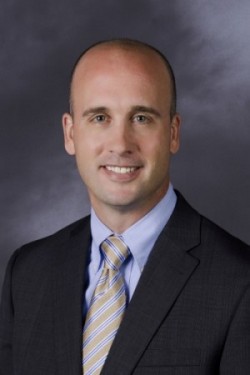
Name: Kurt Smith
Industry: Construction
Organization: Turner Construction Company
Committee: Board of Directors, Governance Committee, Volunteer Manager
LEED AP Since: 2005How did you become interested in sustainable design/construction?
Back in 2004 when I first learned about green building concepts, I attended a couple of training sessions about USGBC and LEED. I was interested in learning more so I decided to pursue the LEED AP credential. I remember reading most of the old LEED-NC Reference Guide while traveling, and it became obvious to me that promoting sustainable design and construction was the right thing to do. So I passed the LEED AP exam and then started looking for ways to learn more and promote green building in Central Ohio. - Why did you decide to join the USGBC?
Well, back in 2005 there wasn’t any opportunity to join USGBC as an individual, since there wasn’t a chapter in Central Ohio. There were other green building groups and events, but nothing formally connected to USGBC. So I got involved in some of the earliest discussions about starting a USGBC chapter here from 2006 to 2008, when the formal process of organizing an official chapter started. I was very active in starting the chapter, because I felt that a larger organization that was formally backed by the USGBC National organization could have more impact in advancing USGBC’s mission, and sustainable design in general. - What are the biggest benefits of being involved with the USGBC COH?
There are numerous benefits. The programs and educational opportunities provided by the USGBC Central Ohio Chapter have always been very interesting, informative and well presented. I try to attend as many of the monthly Lunch and Leaders and quarterly Buildings in Action tours as I can, because it’s great to learn from other professionals in our industry who face similar challenges and come up with innovative solutions for their projects. The annual Design Columbus event – presented by the USGBC COH Chapter and the CSI Columbus Chapter – continues to grow and get better each year. Though I think the greatest benefits are the personal and professional relationships that come from networking and being actively involved with the chapter. - As an industry professional, do you have a particular interest or bring a specific expertise to the LEED rating systems?
I’m most interested in the Energy and Indoor Environmental Quality sections of the LEED rating systems. HVAC systems fascinate me, and they are a large component of the cost of building construction projects. I also think daylight and views are critical in nearly all building types – to improve employee productivity, patient outcomes, student learning, etc. – so it’s interesting to see how architects address those challenges and opportunities with their designs. As an example, the Columbus Metropolitan Library just opened the new Driving Park branch, a project I was involved with through the preconstruction phase. It was really rewarding to walk through the completed building to see how much daylight and views to the outdoors were available to the children in the neighborhood who will be using that library for years as a place to learn. What a huge improvement from how libraries were designed in the past. - How do you spend your time away from USGBC and work?
My wife (Annemarie) and I are into outdoor activities, and I really enjoy running and cycling. We also like spending time with friends, including the really great friends we’ve made from our involvement with the chapter. And I love the local craft brews that are available in our area, Columbus has become a hub for high quality beer.
Ohio Leads the Nation With 150 LEED Certified Schools
FOR IMMEDIATE RELEASE
Contact: Rick Savors, Media Relations Manager
614 466-7746 / [email protected]
July 17, 2014 (COLUMBUS) – The State of Ohio continues to lead the nation in environmentally friendly public school facilities. Officials at the Ohio School Facilities Commission announced today that the Columbus Scioto middle-high school building (grades 6 through 12) in the Columbus City School District has become the 150th public education facility in Ohio to achieve certification from the U.S. Green Building Council (USGBC) LEED® green building rating system. With that certification, Ohio maintains its lead in the number of buildings certified, outdistancing California, its nearest competitor with 108 certified buildings. Another 190 Ohio school buildings are currently in design, under construction, or waiting on final word on their certification applications.
LEED® (Leadership in Energy & Environmental Design) is a points-based rating system that focuses on environmentally-friendly design including energy and water efficiency, sustainable site development, material selection and indoor environmental quality. The LEED criteria rank schools (or buildings) at various levels including Certified, Silver, Gold, and Platinum. Starting in 2007, the OSFC has required that the design of each school building funded through the OSFC must seek Silver certification at a minimum with a goal of achieving Gold. The Columbus Scioto School was awarded a LEED Gold certification. Currently 3 Ohio schools have achieved the Platinum certification, 67 the Gold certification, 77 the Silver, and three (3) others have been Certified.
OSFC Executive Director Richard Hickman called today’s announcement “Exciting and certainly a statement on how Ohio has embraced environmentally friendly design.” He went on to add that “these projects, which represent a commitment to both our school children and the future of our environment, are the direct result of innovative team work from architects, construction managers, trade contractors, and our project partners, the local school districts. I commend them for their accomplishments.”
The Columbus Scioto building is designed to create an atmosphere of educational stimulation while providing significant operational cost savings. For example, the building maximizes the use of natural sunlight to reduce lighting costs and incorporates a state-of-the-art geothermal heating and cooling system that will save energy costs for the district.
Overall, data from Ohio’s 150 LEED certified schools show the buildings are designed to be 33 percent more energy efficient and use an average of 39 percent less water than buildings built to previous standards. The LEED schools also provide a healthier indoor environment for the students and staff.
A complete listing of the LEED schools can be found on the OSFC website (http://osfc.ohio.gov) or at the newly launched Ohio Collection in the Green Building Information Gateway (GBIG) at http://www.gbig.org/collections/12880.








 Facebook